Material archive
From the material archive command you access the tables shown in the following figures, from which it is possible to assign all the input parameters of the soils and of any structural elements that are part of the model.
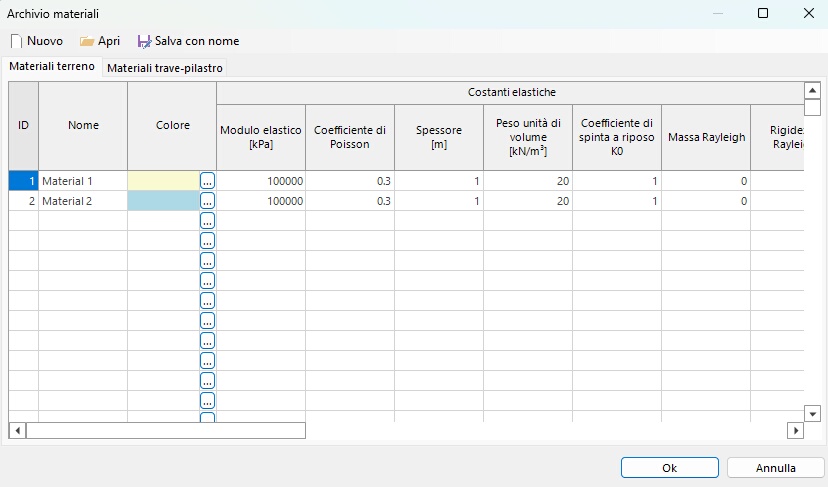
Definition of the soil properties
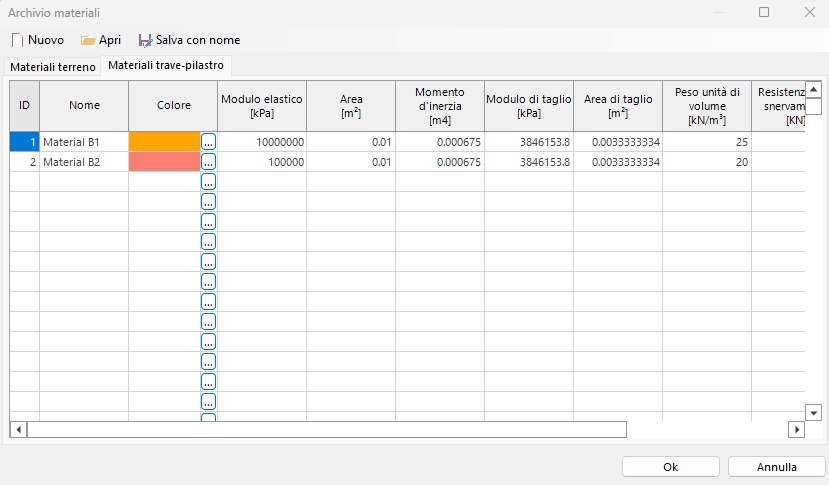
Definition of the structural material properties
For each material the usual geotechnical properties must be assigned (unit weight, K0, deformation modulus, etc.), a decay law of the G/Gmax ratio and of the damping D as a function of the shear strain, and the velocities VS and VP. In the definition of the materials, a layer representing the bedrock must also be included, which will be treated by the software as a material with linear elastic and absorbing behaviour.
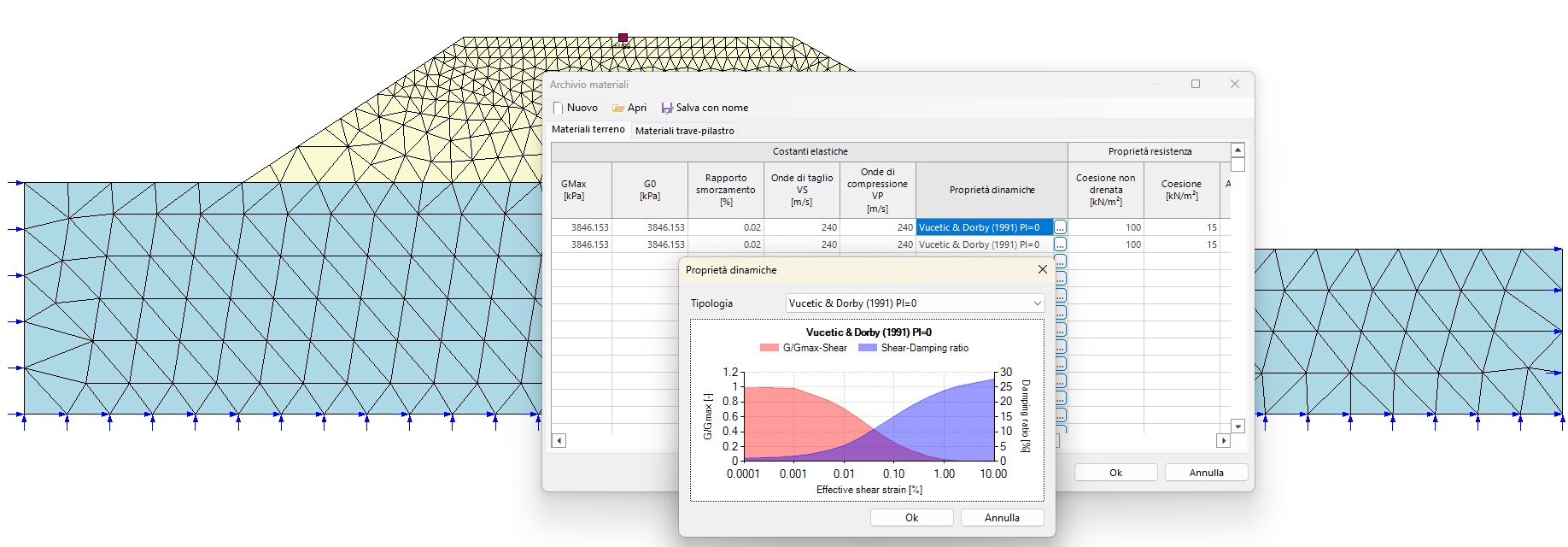
Decay law
The initial values of Gmax and G0 are computed automatically by the program, after entering the velocity VS of the shear waves and the unit weight. The damping ratio is required as a fraction of the critical one. For the Rayleigh Mass and Rayleigh Stiffness data, please refer to the Local seismic response analysis section.
Custom decay curves
The curves offered in the list (Vucetic & Dorby, Seed et al., Idriss) are read from CSV files stored in the shared folder Documents\Geostru\Decay curves. You can add your own curves, obtained for instance from laboratory tests.
Three commands are available in the decay law window:
- Import CSV...: lets you choose one or more CSV files, which are copied into the shared folder and become immediately selectable. Alternatively, the files can be dragged directly onto the window.
- Curves folder: opens the shared folder in File Explorer.
- CSV template...: saves a sample file already in the correct format, with two instruction rows and the values of a real curve to be replaced with your own. Text rows are ignored when reading, so they can be left in the file.
The file has the following structure:
Curve name
g;(G/Go);D
0.0001;1.000;1.163
0.001;0.984;1.827
0.01;0.711;5.399
- the first row is the name under which the curve appears in the list (if missing, the file name is used);
- the second row is the column header;
- each following row contains the shear strain g [%], the ratio G/Gmax [-] and the damping D [%].
Semicolon, comma and tab are accepted as column separators, and both the point and the comma are accepted as decimal separators. The points may be listed in any order, because they are sorted by increasing strain. At least two points are required, with G/Gmax between 0 and 1 and D between 0 and 100%: if the file does not comply with these conditions, an error is reported and the curve is not imported.
If you import a curve whose name already exists, the program asks whether to replace the existing one (the materials using it adopt the new values) or to add it under a new name.
The curves are also saved inside the project file, so a project opened on another computer keeps the custom curves.
Even in the trial version, where the material archive is read-only, it remains possible to import a custom decay curve and assign it to the existing materials.