Smoothing
The smoothing techniques implemented in Easy HVSR are 4. For each of them the smoothing criterion is shown.
Konno & Ohmachi (1998)
This type of smoothing requires that the amplitudes of the frequencies around a central frequency be weighted according to the following formula:
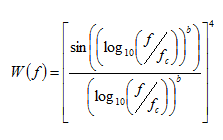
where:
fc represents the central frequency
f the frequency to be weighted
b the band coefficient
The frequency band to be weighted is on a logarithmic scale, and its width is established by the smoothing percentage, i.e. it is equal to the smoothing percentage times the width of the entire band to be smoothed.
Moving average
This type of smoothing requires that the average of the amplitudes of a given frequency interval around a central frequency be computed. The width of the neighborhood to be smoothed is indicated by the value of the smoothing percentage, i.e. it is equal to the smoothing percentage times the entire frequency band to be smoothed.
Constant triangular
This type of smoothing requires that the amplitudes of the frequencies in the neighborhood of a central frequency be weighted according to a linearly decreasing trend from the central frequency, where the weight takes a unit value, to the limit frequency of the neighborhood, where the weight takes a value equal to zero. The neighborhood has a width equal to the smoothing percentage times the width of the entire band to be smoothed.
Proportional triangular
This type of smoothing is the same as the previous one with the difference that the width of the neighborhood is proportional to the central frequency, i.e. equal to the smoothing percentage times the value that the central frequency Fc takes from time to time.
©Geostru