Global stability Analysis
Important: the stability of the structure is checked in Slope
The ESD checks (rigid-block sliding, piping, local checks of the downstream face and uplift) are not enough to guarantee the stability of the embankment. Always complete the analysis with the global stability in Slope (Slope button): Slope receives the section, the materials and the ESD flow net, that is the water pressures computed at every point, and checks all the slip surfaces in the embankment and in the foundation, with full reservoir, empty reservoir and rapid drawdown.
The Slope button (Home tab, Out group) saves a *.LHFTOSLOPE file with the current data of the tabs
and opens it in Slope (if Slope is not installed ESD offers to download it). The analysis should be carried out
with full reservoir, empty reservoir and rapid drawdown. Slope receives:
| Data | From ESD |
|---|---|
| Ground profile | upstream start, upstream toe, crest, downstream face down to the toe and beyond, up to the edge of the foundation layers; when the downstream ground level is above the toe, the profile follows it |
| Water table | maximum reservoir level upstream, phreatic line in the dam body (the phreatic line computed by the finite element analysis, as in the drawing), downstream toe and foundation level downstream |
| Pore pressures | the water pressures computed by the finite element seepage analysis at every mesh node, as a pore pressure grid u(x,y): Slope uses them at the base of the slices instead of the hydrostatic pressure below the water table (u = 0 in impervious materials). If the seepage analysis does not converge the grid is not exported and only the water table is used |
| Layer 1 | dam body: γ, γsat, φ', c', cu |
| Layers 2 and 3 | foundation layers (permeable and impervious) with γ, γsat, φ, c and colour |
| Seismic | amax, kh, kv |
| Upstream toe works | riprap toe (layer 1, the profile runs over it) and riprap foundation (layer between dam body and foundation, only under the block), with c = 0 and φ, γ of the boulders |
| Reinforcements | the downstream face reinforcements (Works tab) as Slope reinforcement elements: length, facing height, wrap, inclination, Tallow, soil-reinforcement friction, pullout coefficient |
ESD coordinates in Slope
Slope shifts the section by 50 m in x and y: the ESD origin (x = 0, y = 0) becomes (50; 50) in Slope and is marked with a red cross. If more than 5% of the pressure grid points fall outside the section, Slope warns that the grid is not aligned. Moving the mouse over the section, Slope shows the water pressure u and the hydraulic head h of the grid, to compare with ESD at the same point (in ESD x and y are 50 m smaller).
Slope opens in SI units (kN/m³, kPa, kN), like ESD, with the layer legend.
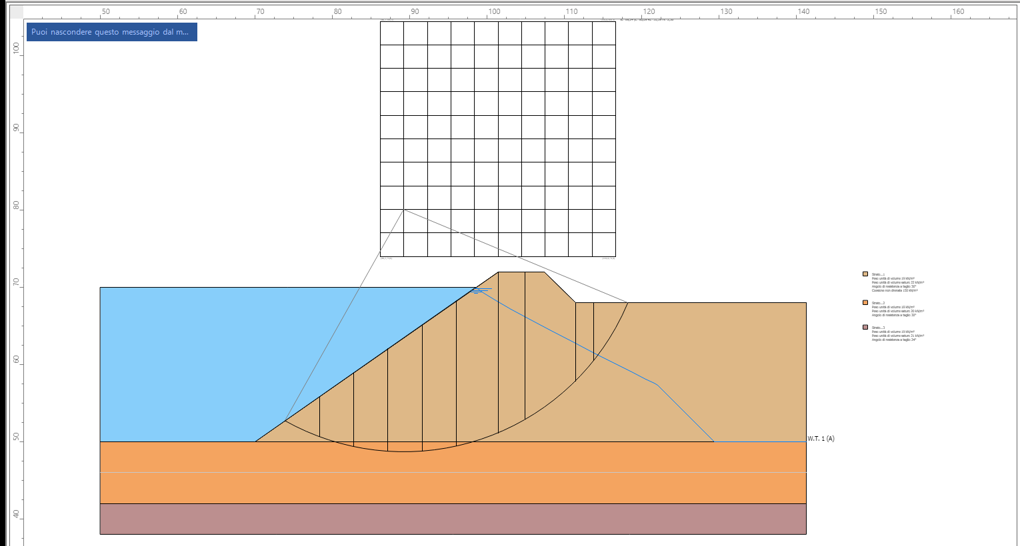
Effective and undrained cohesion
The sliding checks of ESD (full, empty and rapidly drawn-down reservoir) use the effective parameters φ' and c'. The undrained cohesion cu (box to the right of c') is not used by the ESD checks: it is exported to Slope for total-stress analyses.
The following video shows the checks in Slope (full reservoir, rapid drawdown, empty reservoir):
© Geostru